
The Brand Halo: Why a Trusted Parent Brand Makes Every Product Stronger
Many product-driven companies think about growth one item at a time. A new product that responds to a new trend, a new buyer request, or new market opportunity.
And of course, the product has to be good. It has to solve a real problem, fit the channel, make sense at the price point, and deliver on what it promises.
But when every product has to explain itself from scratch, it’s hard to gain traction.
That’s where the brand halo matters.
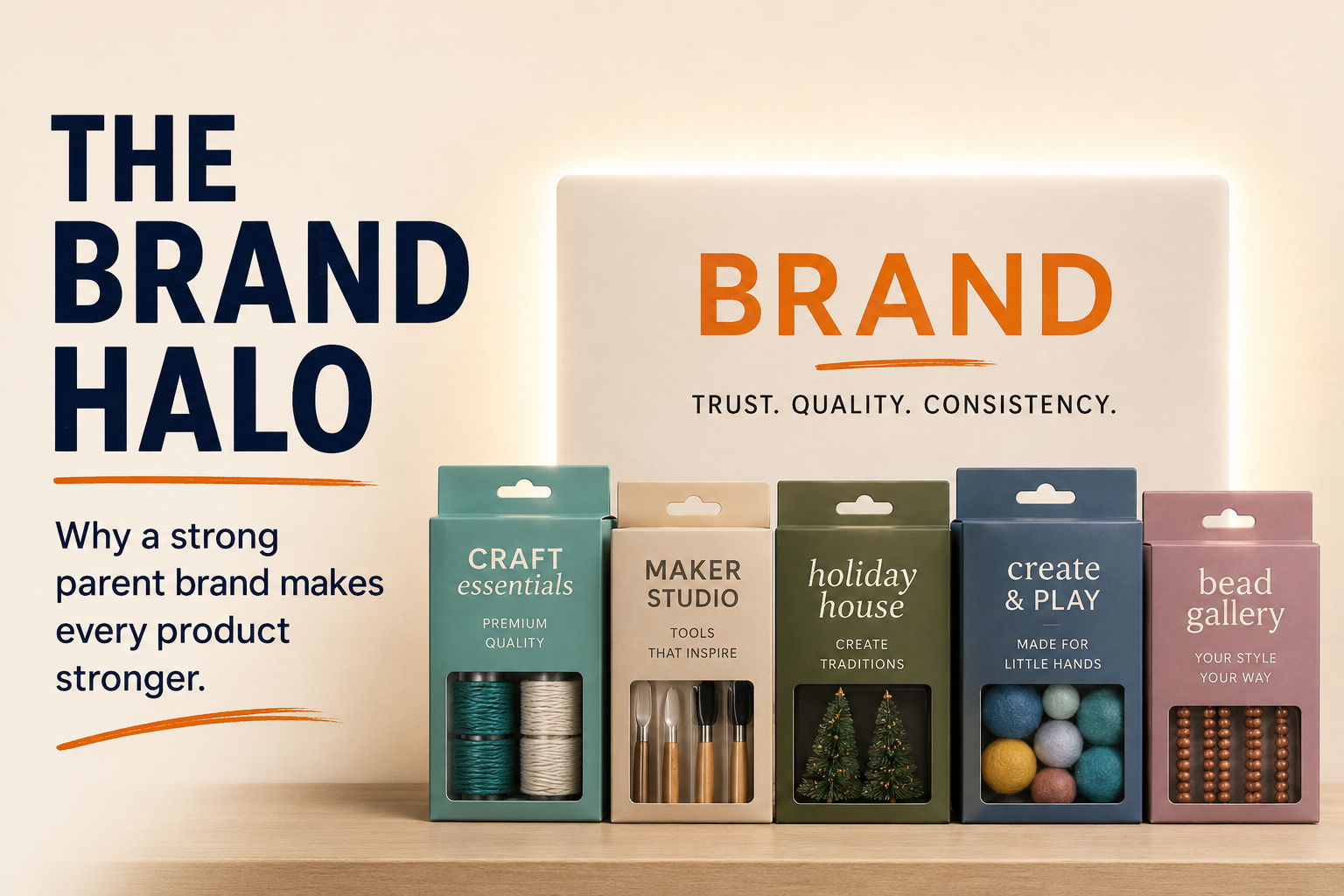
A brand halo is the trust, meaning, and expectation that the parent brand creates around everything underneath it. It gives each product a little more context before the customer even picks it up. It gives new products a sense of familiarity, even when the product itself is new.
That kind of trust is easy to overlook because it doesn’t always look exciting. Sometimes it looks like consistency. Sometimes it looks like reliability. Sometimes it looks like being exactly what the customer expected, in the exact place she expected to find it.
I saw this clearly early in my career at Westrim Crafts.
Westrim was not a glamorous brand, and it was not trying to be. It was a value-driven craft supplier selling into retailers like Michaels, JoAnn, Walmart, Target, and other mass and specialty channels.
And that was exactly the point.
The customer did not need Westrim to feel exclusive or overly polished. She needed the product to be useful, approachable, affordable, and easy to understand. She needed to know what she was buying, how to use it, and why it belonged in her craft room, jewelry box, holiday project, classroom, or weekend hobby.
The brand promise was simple: the product would be designed right, priced right, packaged right, and available where the customer already wanted to shop.
That sounds basic, but there is a lot of discipline behind basic.
You have to understand the customer. You have to understand the retailer. You have to translate trends in a way that feels relevant without making the product harder to buy. You have to create packaging that does the right amount of selling at shelf. You have to know when the customer needs inspiration, when she needs instruction, and when she just needs the product to be clear.
Over time, that consistency created trust around the parent brand.
For consumers, it meant they knew what to expect. They may not have been standing in the aisle thinking about brand architecture, but they were responding to something familiar. The product looked right. The price made sense. The packaging gave them enough confidence to buy.
For retail buyers, the trust worked a little differently, but it was just as important. Westrim had credibility because the company understood the category, the customer, the price point, and the operational realities of retail. Buyers knew the product would not just be creative. It would be commercially viable.
That trust mattered when new products launched. And it mattered when sub-brands were introduced and even when acquired brands were added to the portfolio.
Those brands didn’t have to start from zero. They had the benefit of the parent brand’s reputation behind them. The Westrim name, the retailer relationships, the customer understanding, and the internal product discipline all helped open the door. All because of the commercial power of a trusted parent brand.
A brand halo is the trust, meaning, and expectation that the parent brand creates around everything underneath it.
Sharpie is a familiar example of this.
Sharpie started with a very clear idea: a marker that felt bold, permanent, and dependable. Over time, the brand expanded well beyond the classic black permanent marker. Today, Sharpie shows up across permanent markers, highlighters, (my favorite) pens, paint markers, creative markers, and specialty tools.
That expansion works because the parent brand already carries meaning.
When someone sees the Sharpie name on a new format, they are not starting from a blank slate. They already have a feeling about the brand. They expect strong color. They expect permanence, clarity, confidence, and a tool that does what it says it will do.
So when Sharpie moves into a new tip style, a new surface, a new color range, or a more creative use case, the product benefits from the trust already built by the parent brand.
The customer doesn’t need a long explanation every time. The brand name is doing some of the work.
That is the halo.
And the same idea applies to emerging brands, even on a much smaller scale.
If you are building a consumer brand, your parent brand should help people understand why each product exists and why it belongs in your world. When the parent brand is unclear, every new item has to work harder. Every product page has to over-explain, every launch feels disconnected, and every retailer conversation starts too far back.
But when the parent brand is clear, future products get a lift.
A new product can borrow meaning from the larger brand story. A new collection can feel like a natural extension instead of a random experiment. An acquired brand can be integrated with more confidence because there is already a strategic center holding the portfolio together.
The strongest brands don’t just sell products. They build trust that compounds.
This is especially important for product-first founders and manufacturers moving into branded growth.
When a company has historically led with product, the instinct is often to treat every opportunity as a separate decision. A buyer asks for a variation, so the team makes it. A trend pops up, so the team chases it. A new channel opens, so the team adjusts the product and packaging again.
That can create short-term sales, but without a strong parent brand, the business can become reactive. The line spreads out. The customer gets harder to define. The sales story gets less clear. And eventually, even good products start to feel disconnected from one another.
A brand halo helps prevent that by giving the business a filter for growth.
Does this product strengthen what we want to be known for? Does this sub-brand help the customer navigate our assortment? Does this acquisition add credibility, capability, or customer relevance? Does this launch make the parent brand more meaningful, or does it pull us in another direction?
Those are the questions that protect brand equity as the business grows.
The strongest brands don’t just sell products. They build trust that compounds.
Each good product makes the next product easier to understand. Each strong customer experience makes the next launch feel less risky. Each consistent message adds another layer of credibility.
Over time, the brand becomes more than a name on the package. It signals quality, fit, and value in a way that becomes a lever.
That is what Westrim did well. It did not need to be the most glamorous brand in the aisle. It needed to be trusted. It needed to be relevant. It needed to deliver the right product, in the right way, for the right customer, through the right channel.
And because that trust existed, the parent brand helped open the door for everything that came next.
Your parent brand is not just a logo sitting above your products. It is the meaning system that helps every product make sense.
When it’s strong, your products don’t have to stand alone. They stand within the halo of a brand the customer already understands.