
The Hidden Cost of Moving Fast Without Brand Architecture
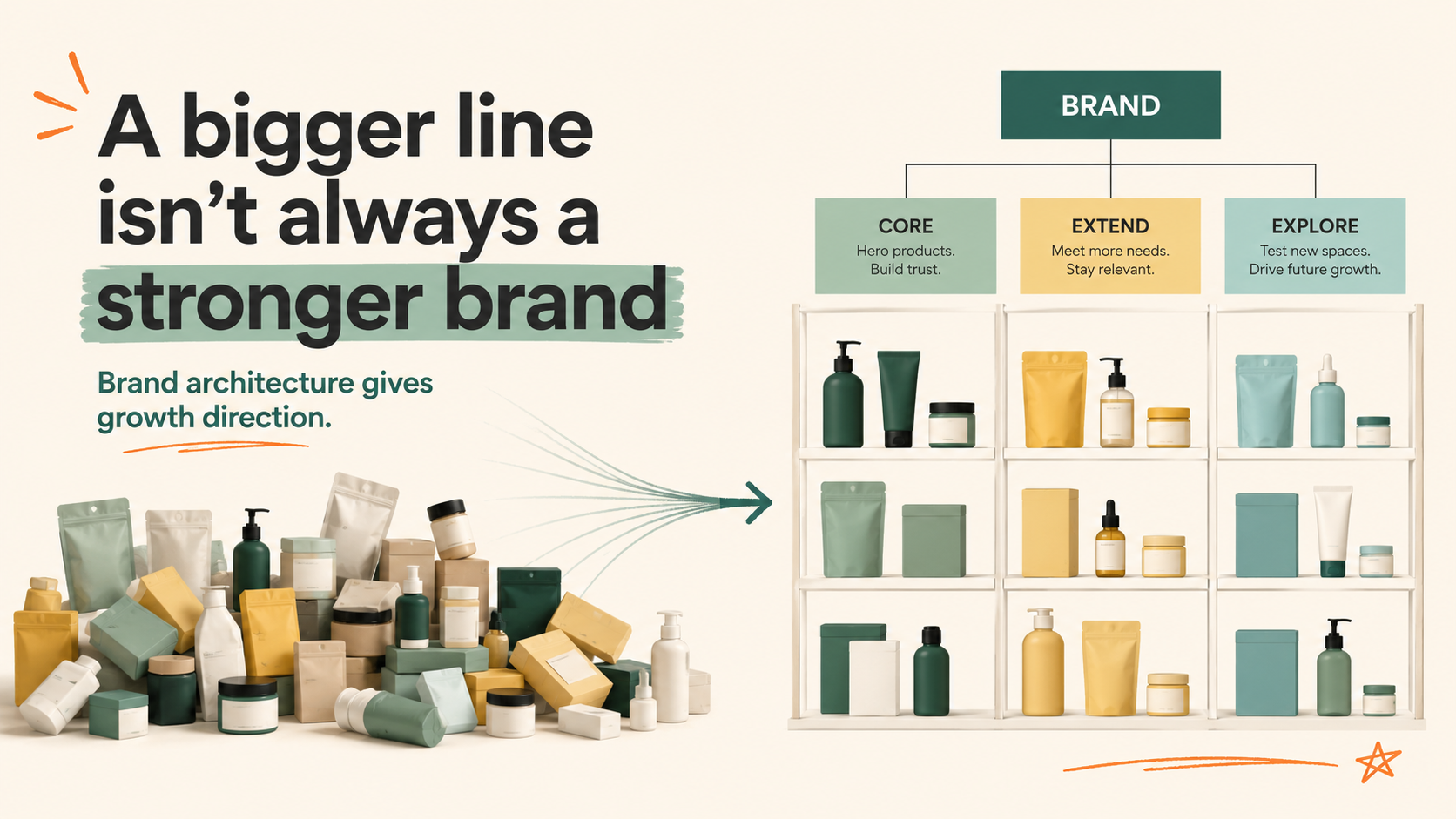
Without structure, more products can send confusing signals to the customer. Structure sets clear expectations.
Small companies can move fast.
It’s one of their biggest advantages, and one of the reasons I like working with founder-led businesses.
There’s less red tape. People are closer to the product. Decisions can happen quickly. A good idea doesn’t have to sit in a conference room for six months while everyone waits to “align.”
That speed can be powerful.
A buyer asks for something slightly different. A trend starts gaining traction. A seasonal opportunity opens up. A new customer segment seems interested. Or the team realizes they already have the manufacturing capability to make something new.
In the moment, saying yes can make perfect sense.
I’ve sat in meetings with buyers from Target, Michaels, JoAnn, Walmart, and other major retailers, and I know how important it is for them to feel like they have some buy-in. That’s not a bad thing. Sometimes their perspective illuminates something the brand team overlooked. Sometimes a buyer sees a customer need, a merchandising gap, or a channel opportunity that deserves attention.
That kind of input can be incredibly valuable.
But there’s another side to it.
I’ve also known buyers who asked for anything and everything because they liked us, trusted us, and knew we could move quickly. And honestly, a lot of those ideas worked. The relationship was strong, the momentum was real, and the ability to respond quickly opened doors.
But not every request turned into an order.
Buyer input is valuable, but buyer enthusiasm still needs to be filtered through brand architecture.
Every now and then, we’d develop the product, produce the inventory, and then the order would be canceled or reduced. Suddenly we were sitting on a large quantity of product that had been created for a specific buyer, a specific shelf, or a specific opportunity.
And the hardest part wasn’t only the inventory.
It was that the product didn’t really fit anywhere else.
It didn’t sit naturally within the brand assortment. It wasn’t easy to merchandise into the existing line. It didn’t ladder back to the core customer story. It had made sense in the context of one opportunity, but once that opportunity disappeared, the product was left without a clear home.
That’s where speed can hide a problem.
When a team is nimble, it becomes very easy to say yes to the buyer request, the trend, the seasonal idea, the new customer segment, or the product just because we have the manufacturing capability.
Each decision may make sense in the moment, especially when there’s buyer interest or a possible revenue opportunity in front of you. Knowing the team can do it, the founder jumps to catch the opportunity.
And I understand that pull. Sometimes I get wrapped up in it too, because it’s exciting to create newness.
But this is usually the moment when I like to slow things down just enough to look at the bigger picture.
Because before long, the line can become bigger without necessarily becoming stronger.
One product was added because a buyer asked for it. Another came from a seasonal trend. Another was built around a different price point. Another was created because the factory could make it. Another was meant to reach a new customer.
Individually, each decision may be reasonable.
Together, they can start to create confusion.
The brand becomes harder to explain. The line becomes harder to merchandise. The sales story becomes less focused. The customer has to work harder to understand what the brand stands for and why each product belongs.
That’s where brand architecture becomes useful.
A disciplined brand architecture gives fast-moving companies a way to keep moving without losing the thread.
It helps the team ask better questions before adding more:
What role does this product play?
Who is it for?
Where does it sit in the line?
Does it strengthen the brand, or does it add complexity we’ll have to explain later?
If the buyer opportunity disappears, does this product still belong?
That last question matters.
Because buyer interest is important, but it shouldn’t be the only reason a product exists.
If the buyer opportunity disappears, does this product still belong?
The commercial opportunity matters. Of course it does. Revenue, distribution, buyer relationships, and market timing are real. And smart brands should listen closely when buyers give feedback.
But the brand has to matter too.
Every new product is not just a product decision. It’s a brand decision. It tells the market something about who the company serves, what it believes in, where it belongs, and what customers can expect next.
I don’t believe emerging brands need to become slow, overly corporate, or buried in process. That would probably kill some of what makes them special.
But they do need enough structure to create healthy tension between brand and commerce.
When there’s no architecture, every new item has to explain itself from scratch.
When there is architecture, each product has a clearer role. The line becomes easier to understand. The sales story becomes more coherent. The customer has more context. And the team has a better way to decide which opportunities deserve a yes.
Small companies should keep the speed that makes them special.
But speed works best when it has direction.
Speed creates opportunities.
Structure makes sure they add up.